Category: Bringing It Into The Light

  • Bringing It Into The Light – PART VIII: Writing as a Lifeline

    Bringing It Into The Light – PART VIII: Writing as a Lifeline

    This post is part of my “Bringing It Into the Light” series, where I explore the journey of naming, healing, and reclaiming my voice.

    Writing isn’t just helping me process what happened — it’s helping me reconnect with myself. It’s become a lifeline, a way to understand my own story, a way to bring things out of the dark and into the light.

    I write to heal. I write to connect. I write to make sense of the parts of my life that once felt impossible to name. And I write because I hope it helps someone else feel less alone.

    Writing is how I stay honest with myself. It’s how I track my growth. It’s how I remember that healing is not a destination — it’s a practice.

    This series is not an ending. It’s an invitation. An invitation to stay with me as I grow, as I learn, as I continue bringing things into the light.

    [Return to the series overview →]

    If any part of this met you where you are, I share more reflections by email.

    Subscribe

  • Bringing It Into The Light – PART VII: For the Woman Who Needs This

    Bringing It Into The Light – PART VII: For the Woman Who Needs This

    This post is part of my “Bringing It Into the Light” series, where I explore the journey of naming, healing, and reclaiming my voice.

    This post is a letter — not to everyone, but to the woman who is still in the dark. The one who is still doubting herself. The one who is still carrying shame. The one who hasn’t yet found the words for what she’s living through.

    To her, I would say:

    You are not imagining things.

    You are not too sensitive.

    You are not dramatic.

    You are not the problem.

    Your experience matters.

    Your voice matters.

    Your pain is real.

    And you deserve to be seen.

    I know the silence feels safer.

    I know the shame feels heavy.

     I know the truth feels dangerous.

    But you are not alone.

    And you are not beyond hope.

    [Return to the series overview →]

    If any part of this met you where you are, I share more reflections by email.

    Subscribe
  • Bringing It Into The Light – PART VI: Reclaiming My Voice

    Bringing It Into The Light – PART VI: Reclaiming My Voice

    This post is part of my “Bringing It Into the Light” series, where I explore the journey of naming, healing, and reclaiming my voice.

    Survival changes you.

    It teaches you to stay quiet, to stay small, to stay contained. But healing asks something different. It asks you to expand again. To trust again. To speak again.

    Reclaiming my voice isn’t happening all at once. It is happening through writing — through the slow, steady practice of telling the truth without apologizing for it. Writing is helping me rebuild parts of myself I once believed were gone: my intuition, my boundaries, my confidence, my sense of identity.

    I am beginning to understand what I like, what I need, what I deserve.

    I am beginning to trust my own perceptions.

    I am beginning to feel connected to myself again.

    And as I write, I notice something else: My voice is not just returning — it is evolving. It is becoming clearer, stronger, more grounded. It is becoming mine.

    Healing is ongoing. Reclaiming my voice is ongoing. And every time I speak the truth — even quietly — I come home to myself a little more.

    [Return to the series overview →]

    If any part of this met you where you are, I share more reflections by email.

    Subscribe

  • Bringing It Into The Light – PART V: Shame, Empathy, and the Work of Healing

    Bringing It Into The Light – PART V: Shame, Empathy, and the Work of Healing

    This post is part of my “Bringing It Into the Light” series, where I explore the journey of naming, healing, and reclaiming my voice.

    Shame thrives in secrecy.

    It grows in the dark, in the quiet, in the places where you convince yourself that your experience is too embarrassing, too messy, too complicated to share. For years, shame kept me silent. It told me that speaking the truth would make people judge me. It told me that I should have known better. It told me that what happened was somehow my fault.

    Brené Brown says that shame cannot survive being spoken.

    Empathy is its antidote.

    I didn’t understand that until the day my coworker shared her story. Her empathy loosened something in me — something that had been locked tight for years. It didn’t erase the shame, but it weakened it. It made space for compassion. It made space for truth.

    Healing is not a single moment.

    It is a series of small, brave acts.

    Telling the truth.

    Letting someone see you.

    Letting yourself be human.

    Writing has become part of that work.

    Each sentence I put on the page disarms a little more shame.

    Each story I share makes the silence less powerful.

    Each truth I name makes the past less heavy.

    [Return to the series overview →]

    If any part of this met you where you are, I share more reflections by email.

    Subscribe

  • Bringing It Into The Light – PART IV: Naming What Happened

    Bringing It Into The Light – PART IV: Naming What Happened

    This post is part of my “Bringing It Into the Light” series, where I explore the journey of naming, healing, and reclaiming my voice.

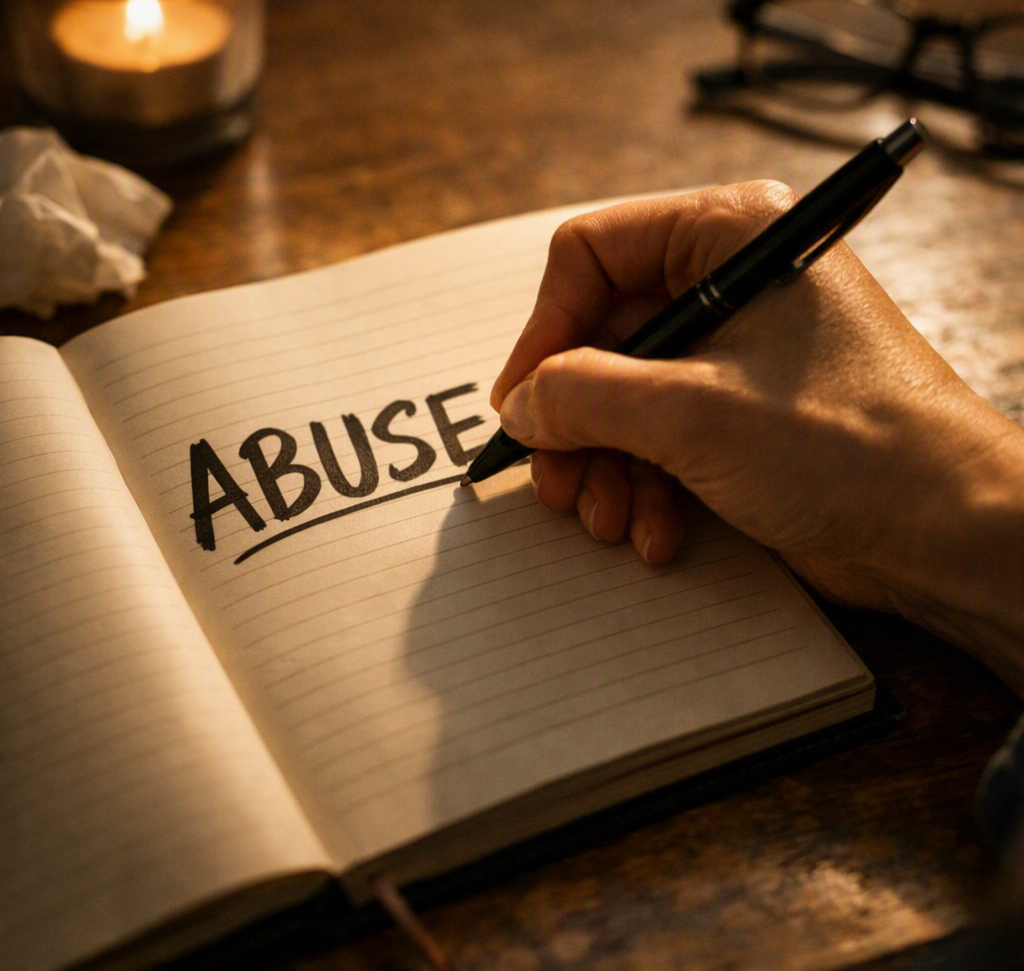
    There is a particular kind of courage required to name something you’ve spent years avoiding. For me, that word was abuse. Even now, it feels heavy. It feels too big. It feels like a word that belongs to someone else’s story — someone who went through something worse, something more obvious, something more dramatic.

    But the truth is simple:

    If you are being diminished, controlled, dismissed, or made to doubt your own reality, you are being harmed.

    And harm has a name.

    Using the word abuse felt impossible at first. It carried shame. It carried fear. It carried the weight of every moment I had minimized or rationalized. Saying it out loud made everything real — and real things demand to be faced.

    Language is powerful.

    It can feel like a spotlight, exposing everything you tried to hide.

    It can feel like a burden, too heavy to carry.

    But it can also be liberating.

    Naming what happened didn’t change the past, but it changed my relationship to it. It allowed me to stop fighting myself. It allowed me to stop pretending. It allowed me to stop shrinking. It allowed me to begin healing.

    [Return to the series overview →]

    If any part of this met you where you are, I share more reflections by email.

    Subscribe
  • Bringing It Into The Light – Part III: The Moment Everything Shifted

    Bringing It Into The Light – Part III: The Moment Everything Shifted

    This post is part of my “Bringing It Into the Light” series, where I explore the journey of naming, healing, and reclaiming my voice.

    There are moments that don’t look dramatic from the outside but change everything on the inside. Mine happened in a break room at work, during a conversation I was not expecting and didn’t know I needed.

    A coworker — someone I liked but don’t know well — shared her story. She talked about her marriage, the ways she had been dismissed, diminished, and made to doubt herself. She spoke quietly, almost matter‑of‑factly, but every word landed in me like a truth I’d been trying not to see. Her story wasn’t identical to mine, but it was close enough that something inside me cracked open.

    For the first time, I felt seen. Not because she was looking at me, but because she named an experience I’d been living in silence.

    I spent years convincing myself I was imagining things. That I was too sensitive. That I was overreacting. That if I just tried harder, things would get better. Hearing her speak made all of those rationalizations fall away. It was like someone turned on a light in a room I didn’t realize I was sitting in.

    Empathy is transformative.

    It doesn’t fix the situation, but it changes your relationship to it.

    It gives you language.

    It gives you perspective.

    It gives you permission to believe your own experience.

    I went home that night and cried — really cried — for the first time since the separation and divorce. Not because I was falling apart, but because I finally understood that I was not alone. I wasn’t imagining things. I wasn’t crazy. I wasn’t the problem.

    That conversation didn’t heal me, but it shifted me.

    It was the first moment I realized that connection could be a catalyst for healing — that someone else’s truth could help me see my own.

    [Return to the series overview →]

    If any part of this met you where you are, I share more reflections by email.

    Subscribe
  • Bringing It Into the Light — Part II: The Silence I Lived In

    Bringing It Into the Light — Part II: The Silence I Lived In

    This post is part of my “Bringing It Into the Light” series, where I explore the journey of naming, healing, and reclaiming my voice.

    There are forms of abuse that never announce themselves. They don’t begin with shouting or threats or broken things. They begin quietly — in the small ways you learn to minimize your own experience, rationalize someone else’s behavior, and shrink yourself just enough to keep the peace. Before you even realize what’s happening, silence becomes the language you live in.

    For me, silence didn’t arrive all at once. It formed slowly, almost gently, in the spaces where I stopped trusting my own reactions. When something hurt, I told myself it wasn’t that bad. When something felt wrong, I convinced myself I was overreacting. When I felt dismissed, I tried to be more understanding. Each time I softened my truth, I made myself a little smaller.

    That’s how secrecy begins — not with a conscious decision to hide, but with the gradual erosion of your voice.

    You learn to keep certain things to yourself. You learn to avoid conversations that might lead to conflict. You learn to swallow discomfort before it becomes visible. You learn to carry pain quietly because speaking it feels dangerous.

    And the world around you often reinforces that silence. People see the surface — the functioning, the smiling, the managing — and assume everything is fine. When no one notices the shrinking, you start to believe it’s normal. You start to believe it’s your job to endure quietly.

    Silence becomes a survival strategy. Not because you’re weak, but because you’re trying to stay intact.

    It’s easier to rationalize than to confront. Easier to minimize than to name what’s happening. Easier to disappear inside yourself than to risk being misunderstood.

    The danger of this kind of silence is that it feels protective at first. It feels like control. But over time, it becomes a cage. You lose the ability to articulate your needs. You lose the confidence to trust your instincts. You lose the sense that your experience matters. You lose your voice — not because someone stole it, but because you learned to stop using it.

    This is why the silence matters. Because so many people live in it long before they ever recognize their situation as abuse. Because silence is often the first wound — the one that makes all the others possible. Because naming the silence is often the first step toward bringing anything into the light.

    Part II isn’t about the events themselves. It’s about the quiet conditions that allowed them to take root. It’s about the shrinking, the rationalizing, the minimizing — the subtle ways you learn to disappear. It’s about understanding that silence is not peace; it’s a warning.

    And it’s about beginning to reclaim the voice you didn’t realize you’d lost.

    [Return to the series overview →]

    If any part of this met you where you are, I share more reflections by email.

    Subscribe