Tag: mental-health

  • When Memory Protects Instead of Preserves

    When Memory Protects Instead of Preserves

    I’ve been reconnecting with someone from my past — someone who once held a very real place in my heart. Hearing them talk about those years has stirred something tender in me. They remember our closeness with such warmth, such detail, such affection. And I find myself wishing I could hold those memories the way they do.

    Back then, my mind was carrying so much. Trauma I didn’t know how to name. Fear I didn’t know how to soothe. And the grief of losing a child before I ever had the chance to meet them. My heart was overwhelmed, trying to survive pain that felt too big to face. And in that protective fog, so many soft moments slipped away.

    Listening now, I can feel the truth of what we shared — not through my own memories, but through the way their voice softens when they speak about it. Through the way those moments still seem to live inside them. It makes me ache in a quiet way, not for the past itself, but for the pieces of it I can’t access. The closeness I know existed, even if I can’t see it clearly.

    I wish I could remember the way they do. I wish I could feel those moments with the same warmth. Not to recreate anything, not to rewrite history, but simply to honor what was real between us — the tenderness, the connection, the way we fit together before life became too heavy for me to hold anything else.

    I don’t think those memories are gone. I think they’re tucked away in a part of my mind that wasn’t safe to open back then. And reconnecting now — hearing their stories, feeling the echoes of who we were — makes me wonder if healing might eventually make space for remembering.

    Maybe one day those memories will return.

    Maybe they’ll stay soft around the edges.

    Either way, I’m learning to honor the truth:

    I loved deeply. I lived those moments. They mattered.

    And even if I can’t remember them the way someone else does, the imprint of that closeness is still here, quietly shaping the way I feel when I hear their voice now.

    🎧 Listen to the companion song on Suno → [listen here]

    This song was written for this moment — a softened echo from the same voice, held under a different name.

    If any part of this met you where you are, I share more reflections by email.

    Subscribe
  • Bringing It Into The Light – PART VIII: Writing as a Lifeline

    Bringing It Into The Light – PART VIII: Writing as a Lifeline

    This post is part of my “Bringing It Into the Light” series, where I explore the journey of naming, healing, and reclaiming my voice.

    Writing isn’t just helping me process what happened — it’s helping me reconnect with myself. It’s become a lifeline, a way to understand my own story, a way to bring things out of the dark and into the light.

    I write to heal. I write to connect. I write to make sense of the parts of my life that once felt impossible to name. And I write because I hope it helps someone else feel less alone.

    Writing is how I stay honest with myself. It’s how I track my growth. It’s how I remember that healing is not a destination — it’s a practice.

    This series is not an ending. It’s an invitation. An invitation to stay with me as I grow, as I learn, as I continue bringing things into the light.

    [Return to the series overview →]

    If any part of this met you where you are, I share more reflections by email.

    Subscribe

  • Bringing It Into The Light – PART VII: For the Woman Who Needs This

    Bringing It Into The Light – PART VII: For the Woman Who Needs This

    This post is part of my “Bringing It Into the Light” series, where I explore the journey of naming, healing, and reclaiming my voice.

    This post is a letter — not to everyone, but to the woman who is still in the dark. The one who is still doubting herself. The one who is still carrying shame. The one who hasn’t yet found the words for what she’s living through.

    To her, I would say:

    You are not imagining things.

    You are not too sensitive.

    You are not dramatic.

    You are not the problem.

    Your experience matters.

    Your voice matters.

    Your pain is real.

    And you deserve to be seen.

    I know the silence feels safer.

    I know the shame feels heavy.

     I know the truth feels dangerous.

    But you are not alone.

    And you are not beyond hope.

    [Return to the series overview →]

    If any part of this met you where you are, I share more reflections by email.

    Subscribe

  • Bringing It Into The Light – PART VI: Reclaiming My Voice

    Bringing It Into The Light – PART VI: Reclaiming My Voice

    This post is part of my “Bringing It Into the Light” series, where I explore the journey of naming, healing, and reclaiming my voice.

    Survival changes you.

    It teaches you to stay quiet, to stay small, to stay contained. But healing asks something different. It asks you to expand again. To trust again. To speak again.

    Reclaiming my voice isn’t happening all at once. It is happening through writing — through the slow, steady practice of telling the truth without apologizing for it. Writing is helping me rebuild parts of myself I once believed were gone: my intuition, my boundaries, my confidence, my sense of identity.

    I am beginning to understand what I like, what I need, what I deserve.

    I am beginning to trust my own perceptions.

    I am beginning to feel connected to myself again.

    And as I write, I notice something else: My voice is not just returning — it is evolving. It is becoming clearer, stronger, more grounded. It is becoming mine.

    Healing is ongoing. Reclaiming my voice is ongoing. And every time I speak the truth — even quietly — I come home to myself a little more.

    [Return to the series overview →]

    If any part of this met you where you are, I share more reflections by email.

    Subscribe
  • Bringing It Into The Light – PART V: Shame, Empathy, and the Work of Healing

    Bringing It Into The Light – PART V: Shame, Empathy, and the Work of Healing

    This post is part of my “Bringing It Into the Light” series, where I explore the journey of naming, healing, and reclaiming my voice.

    Shame thrives in secrecy.

    It grows in the dark, in the quiet, in the places where you convince yourself that your experience is too embarrassing, too messy, too complicated to share. For years, shame kept me silent. It told me that speaking the truth would make people judge me. It told me that I should have known better. It told me that what happened was somehow my fault.

    Brené Brown says that shame cannot survive being spoken.

    Empathy is its antidote.

    I didn’t understand that until the day my coworker shared her story. Her empathy loosened something in me — something that had been locked tight for years. It didn’t erase the shame, but it weakened it. It made space for compassion. It made space for truth.

    Healing is not a single moment.

    It is a series of small, brave acts.

    Telling the truth.

    Letting someone see you.

    Letting yourself be human.

    Writing has become part of that work.

    Each sentence I put on the page disarms a little more shame.

    Each story I share makes the silence less powerful.

    Each truth I name makes the past less heavy.

    [Return to the series overview →]

    If any part of this met you where you are, I share more reflections by email.

    Subscribe

  • Bringing It Into The Light – PART IV: Naming What Happened

    Bringing It Into The Light – PART IV: Naming What Happened

    This post is part of my “Bringing It Into the Light” series, where I explore the journey of naming, healing, and reclaiming my voice.

    There is a particular kind of courage required to name something you’ve spent years avoiding. For me, that word was abuse. Even now, it feels heavy. It feels too big. It feels like a word that belongs to someone else’s story — someone who went through something worse, something more obvious, something more dramatic.

    But the truth is simple:

    If you are being diminished, controlled, dismissed, or made to doubt your own reality, you are being harmed.

    And harm has a name.

    Using the word abuse felt impossible at first. It carried shame. It carried fear. It carried the weight of every moment I had minimized or rationalized. Saying it out loud made everything real — and real things demand to be faced.

    Language is powerful.

    It can feel like a spotlight, exposing everything you tried to hide.

    It can feel like a burden, too heavy to carry.

    But it can also be liberating.

    Naming what happened didn’t change the past, but it changed my relationship to it. It allowed me to stop fighting myself. It allowed me to stop pretending. It allowed me to stop shrinking. It allowed me to begin healing.

    [Return to the series overview →]

    If any part of this met you where you are, I share more reflections by email.

    Subscribe

  • The Quiet Return of Myself

    The Quiet Return of Myself

    There are little moments that hit me harder than I expect. Not dramatic ones — not the big life changes or the milestones — but the tiny, ordinary flashes that make me realize just how much of myself I had lost.

    Singing at full volume in the car. Dancing around the kitchen while I make dinner. Picking up my guitar again, even though I still barely know how to play it.

    These small things used to be effortless parts of who I was. Joyful, instinctive, unselfconscious. And somewhere along the way, I stopped doing them. Not all at once, not in a way I noticed. They just slipped quietly out of my life, one by one, until the silence felt normal.

    I didn’t realize how long they’d been gone until recently, when they started coming back.

    It wasn’t intentional. One day I just started singing out loud, and halfway through the second or third song, it hit me: I haven’t done this in years. The realization landed with a mix of sadness and relief — sadness for how long I’d been holding myself small, and relief that something inside me was finally loosening.

    As these pieces return, they bring waves of emotion with them. Sometimes it’s overwhelming. Sometimes it’s tender. Sometimes it’s a grief I didn’t know I was carrying. I’m sad that I let these parts of me disappear for so long. I’m sad that I learned to quiet myself to fit into a life that didn’t make space for me.

    But I’m also deeply, fiercely grateful.

    Grateful that I’m reconnecting with the things that make me feel alive. Grateful that I’m remembering who I am when I’m not shrinking. Grateful that I am, slowly and steadily, coming back to myself.

    This return isn’t loud or dramatic. It’s happening in the kitchen, in the car, in the soft corners of my everyday life. And maybe that’s the most beautiful part — that I’m finding myself again in the places I didn’t realize I’d abandoned.

    I’m learning to take up space again. I’m learning to feel joy without apologizing for it. I’m learning to be myself, fully, without hesitation.

    And I’m not losing her again.

    If any part of this met you where you are, I share more reflections by email.

    Subscribe
  • The First Disappearance: What I Learned in the Dark

    The First Disappearance: What I Learned in the Dark

    I’ve been writing lately about the depression I carried through my marriage — the quiet kind that settles into your bones when you’ve spent too long being unseen. But as I’ve been exploring that part of my story, another memory has been pushing its way to the surface. A much older one. A root system I didn’t realize was still alive under everything.

    It was during the first couple of years after my parents divorced. I was twelve, maybe thirteen. Those years were marked by a kind of emotional loneliness I didn’t have language for at the time. My mom was doing her best to rebuild a life after a painful ending, and I was trying to understand a world that suddenly felt unfamiliar. We were both navigating things we didn’t know how to talk about.

    During that time, someone in our home often made me feel small — too dramatic, too sensitive, too much. He wasn’t physically violent, but the verbal and emotional jabs were constant. The mocking, the belittling, the comments that made me want to disappear. I didn’t understand why it affected me so deeply; I just knew it did.

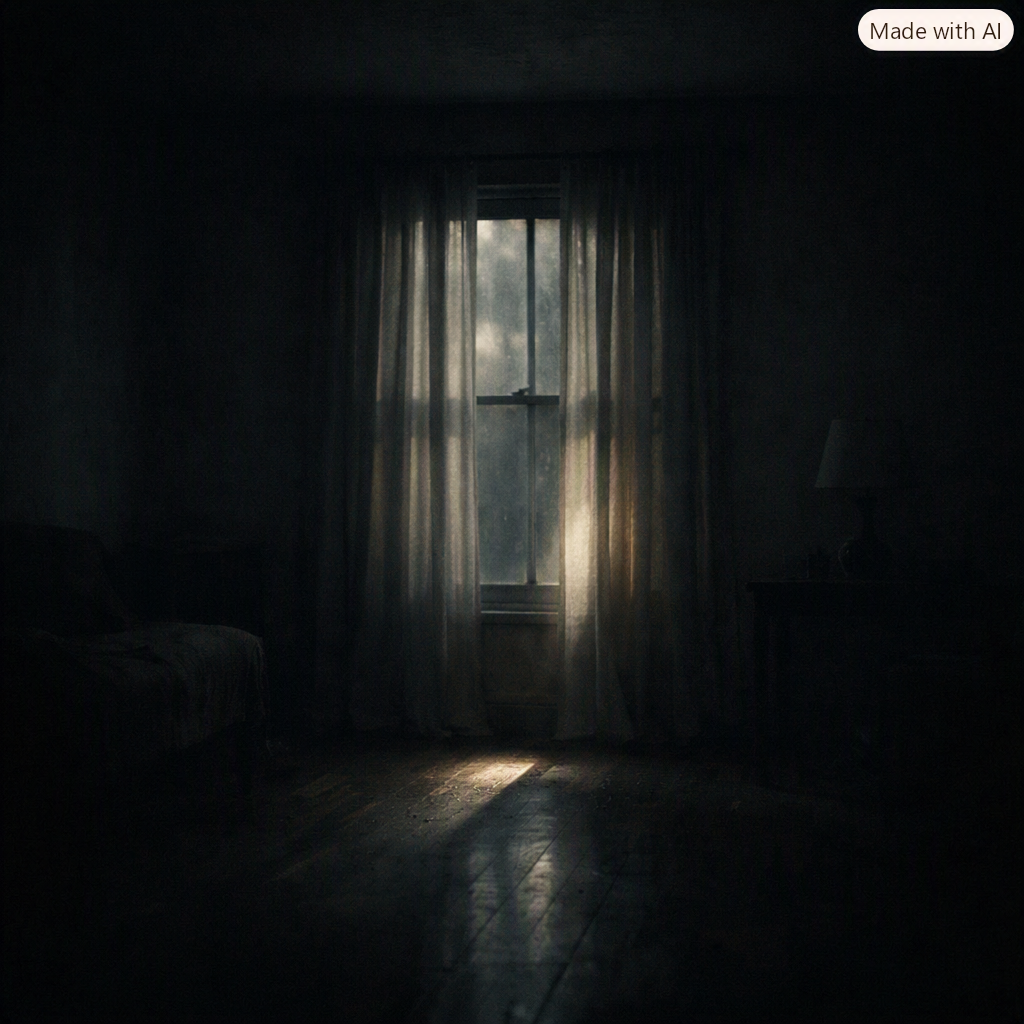
    I remember coming home from school and going straight to the living room. I would draw the curtains closed and sit in the dark. It wasn’t a dramatic gesture — it was the only place I felt like I could disappear. No one asked why. No one wondered what was happening inside me. He would come into the room, throw the curtains open, and announce that I was “a vampire.”

    I learned early that being unseen felt safer than being noticed.

    I didn’t know the word depression then. Back in the early nineties, it wasn’t something people talked about unless they were whispering about someone who needed to be “put away.” I just knew I felt heavy and lonely and wrong. I knew I didn’t fit anywhere. And I knew that the adults around me were carrying their own storms, unable to see mine.

    Looking back now, I can see that this was the beginning of my disappearance — the first time I folded myself inward because the world around me didn’t have room for my pain.

    This is where the pattern started.

    This piece is part of my series, Disappearing: A Story in Three Parts.” [Return to the series overview →]

    If any part of this met you where you are, I share more reflections by email.

    Subscribe
  • Bringing It Into the Light — Part II: The Silence I Lived In

    Bringing It Into the Light — Part II: The Silence I Lived In

    This post is part of my “Bringing It Into the Light” series, where I explore the journey of naming, healing, and reclaiming my voice.

    There are forms of abuse that never announce themselves. They don’t begin with shouting or threats or broken things. They begin quietly — in the small ways you learn to minimize your own experience, rationalize someone else’s behavior, and shrink yourself just enough to keep the peace. Before you even realize what’s happening, silence becomes the language you live in.

    For me, silence didn’t arrive all at once. It formed slowly, almost gently, in the spaces where I stopped trusting my own reactions. When something hurt, I told myself it wasn’t that bad. When something felt wrong, I convinced myself I was overreacting. When I felt dismissed, I tried to be more understanding. Each time I softened my truth, I made myself a little smaller.

    That’s how secrecy begins — not with a conscious decision to hide, but with the gradual erosion of your voice.

    You learn to keep certain things to yourself. You learn to avoid conversations that might lead to conflict. You learn to swallow discomfort before it becomes visible. You learn to carry pain quietly because speaking it feels dangerous.

    And the world around you often reinforces that silence. People see the surface — the functioning, the smiling, the managing — and assume everything is fine. When no one notices the shrinking, you start to believe it’s normal. You start to believe it’s your job to endure quietly.

    Silence becomes a survival strategy. Not because you’re weak, but because you’re trying to stay intact.

    It’s easier to rationalize than to confront. Easier to minimize than to name what’s happening. Easier to disappear inside yourself than to risk being misunderstood.

    The danger of this kind of silence is that it feels protective at first. It feels like control. But over time, it becomes a cage. You lose the ability to articulate your needs. You lose the confidence to trust your instincts. You lose the sense that your experience matters. You lose your voice — not because someone stole it, but because you learned to stop using it.

    This is why the silence matters. Because so many people live in it long before they ever recognize their situation as abuse. Because silence is often the first wound — the one that makes all the others possible. Because naming the silence is often the first step toward bringing anything into the light.

    Part II isn’t about the events themselves. It’s about the quiet conditions that allowed them to take root. It’s about the shrinking, the rationalizing, the minimizing — the subtle ways you learn to disappear. It’s about understanding that silence is not peace; it’s a warning.

    And it’s about beginning to reclaim the voice you didn’t realize you’d lost.

    [Return to the series overview →]

    If any part of this met you where you are, I share more reflections by email.

    Subscribe
  • When Old Wounds Echo Through New Moments

    When Old Wounds Echo Through New Moments

    This week, something small and unexpected stirred up emotions I’ve carried for a long time — the kind that sit quietly until life brushes against them just right.

    My mom is preparing to move to a new state, and part of that process meant finding new homes for two of her pets. I know decisions like that are never simple, and I’m sure she had her own heartbreak to navigate. But when I heard about it, something in me tightened. Not because of the logistics — but because of the feeling of sudden change, of something familiar being uprooted.

    My heart ached for the animals — for the shift in their world, for the loss of the security they trusted, for the feeling of being left. They were going somewhere partially familiar, but not home. And that stirred something deeper in me.

    The intensity of my reaction surprised me. It was more than empathy. It was personal.

    Sometimes, moments in the present echo feelings from the past — not because anyone is doing something wrong, but because our hearts remember things long after our minds have moved on. Growing up, there were seasons of transition, moments of separation, times when life shifted faster than I could understand. Those experiences shaped me in ways I’m still discovering.

    They made me someone who fights for the underdog. Someone who cannot bear the thought of anyone — person or animal — feeling unwanted, unseen, or unloved. Someone who steps in, even when it costs me.

    And that part of me — the part that aches at the idea of abandonment — followed me into adulthood. It shaped the way I loved, the way I protected, the way I tried to fix things that weren’t mine to fix. It made me believe that if I could just love someone enough, make them feel wanted enough, everything would finally be okay.

    This week reminded me that the things we carry from childhood don’t disappear. They echo. They surface in unexpected places. They shape the way we love, the way we protect, the way we choose.

    And sometimes, they show us exactly where we still need healing.

    If any part of this met you where you are, I share more reflections by email.

    Subscribe